|
My comments are
in italics below
Bob:
Thanks for that great eye splice demonstration.
I found several ideas
to add to my toolbox of splicing techniques. I have a couple
of others
I would like to share with you. I stole these ideas fair and
square
from several others, so there is no shame in stealing them from
me if
you like.
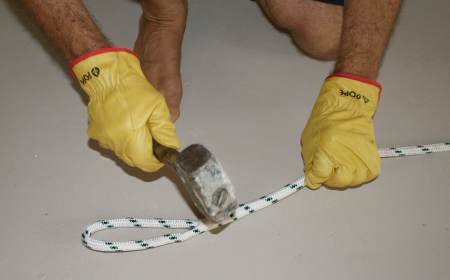
Instead of hammering on your splice, with
the attendant risk of damaging
some of the fibers and ending with an uneven distribution of
materials
inside the doubled section, lay the nearly finished splice on
a clean
floor and using your shoe sole roll the entire doubled portion
back and
forth repeatedly. This gentler pressure and repeated rolling
'works'
the uneven portions into place, whereas the hammer approach crushes
the
lumps without redistributing them laterally inside the outer
sheath.
This technique works fine for layed line splices as well as braid.
I did say use the hammer
gently and I got a letter from a dutch sailor that said the hammer
was actually traditional, but if you have good results rolling
with the shoe, go with what works for you but I do not think
use of the hammer as described is harmful to the ropes fibers.
Another trick to make feeding ends easier
and the finished splice
smoother is to cut core ends on as long a taper as you can. Wrap
the
section to be cut first with masking tape, use a razor blade
to make as
long a tapered cut as possible and immediately retape the resulting
tapered tip (or try the paraffin wax trick below).
Instead of taping the core end to the outside
of the original core (???) it
can be untaped and carefully worked into the interior and held
in place
with a couple of Sews Awl stitches across the point where it
last
entered the original core in place of the PVC tape that would
end up
buried at the bitter end of your splice. That, by the way is
where your
test splice broke, when the seizing/whipping tape that remained
inside
the sheath was not compressing as the line stretched, but instead
the
edge of that blunt end chafed the outer sheath fibers, initiating
the
failure.
The splice did not break.
The break was clear of the work and I really doubt the tape used
had anything to do with the break. I think it was caused entirely
by a few tons of steel in opposition to each other. There was
a change in mass at that point and when the whole unit is challenged
to the point of breaking, that is a likely spot.
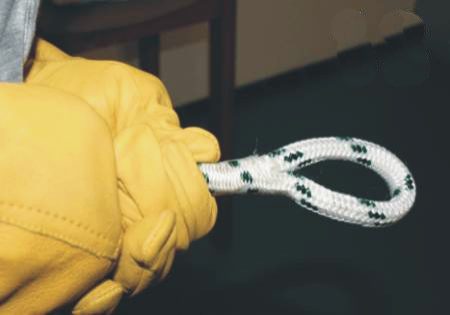
The spliced eye should always be made large
enough that the "Y" part
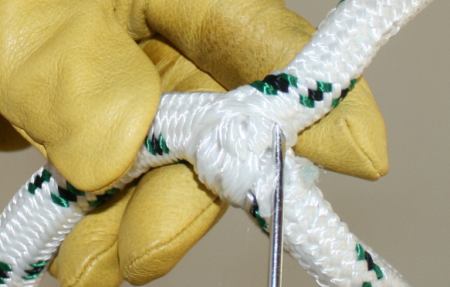
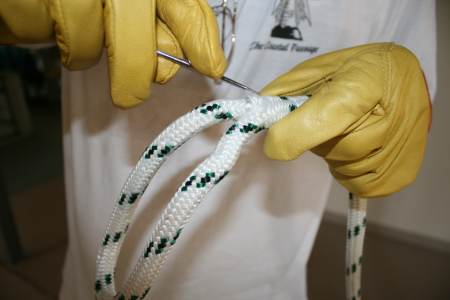
(the throat) is not splayed apart much when under strain. I often
seize
that area with waxed Sews Awl twine, secured at each of the three
ends
with several decorative back stitches.
Define "much"
but in genral I agree. I would express it as "too much".
And all the seizing work you describe shouldn't be required if
the splice is done correctly.
I have a big splicing project at hand making
all new fancy custom
mooring lines for my big boat, and I intend to experiment with
using
melted canning paraffin wax in place of tape to make the temporary
whippings. The melted wax can soak into the interior of the braid
(or
layed) line and bind all the fibers in place when it solidifies.
The
resultant wax/fiber is soft enough to be cut with a razor blade
or sharp
knife, can be molded to tapered/pointed shapes by hand and is
slippery
enough when cold (and wet) to pass easily through outer braid,
for
instance. When the splice is finished the wax can be removed
from the
interior with hot water, good
luck with that! and any remaining
will soften when the splice
heats under load, lubricating the interior, which might not work to advantage, preventing 'internal chafing.' Of course I don't
expect anybody to play with a pot of melted
wax in their sailboat cockpit, but at my workbench it should
work just
fine.
Your thoughts?
My thoughts? I think
thank you very much for adding to the knowledge pool! This page
is proof there are numerous ways to skin a kitty and some methods
will work better for some so all are valid. Find what is best
for YOU!
Gary Bell
34' power catamaran "Stray Cat" and
80' sidewheel paddleboat "Liberty Belle"
berthed in Multnomah Channel near Portland, Oregon |